Exploring the Power of Large-Scale Play
Published on 02/01/2026 in Outdoor & Physical Development

Contributed article: Nick Corlett, Sustainability Manager,
London Early Years Foundation (LEYF)
Large-scale play expands the principles of small-world play into a full-bodied, spatial experience. Instead of arranging tiny figures on a tabletop farm, children might build a life-size barn from crates and fabric. This means that instead of moving a small toy car through a pretend town, they become the driver, the shopkeeper, the firefighter, or even the chef.
Key Characteristics
Scale
Large-scale play uses open spaces alongside oversized props and loose parts such as large boxes, tubes, planks, crates, branches, and tarpaulins. Children can then physically enter and manipulate the environment.
Physicality
It promotes gross motor development, offering opportunities for lifting, carrying, climbing, dragging, balancing, and running. These whole-body movements contrast with the fine motor skills emphasised in small world play.
Immersion
Children inhabit the play environment. A cardboard city, a giant spaceship, or an outdoor ‘forest’ becomes a world they can explore, redesign, and control, making learning deeply sensory and embodied.
Dramatic Role-Play
Children take on characters themselves, using life-size props, costumes, and real tools to support rich socio-dramatic play. They negotiate roles, collaborate on shared ideas, and practice empathy and communication.
Why Large-Scale Play Matters
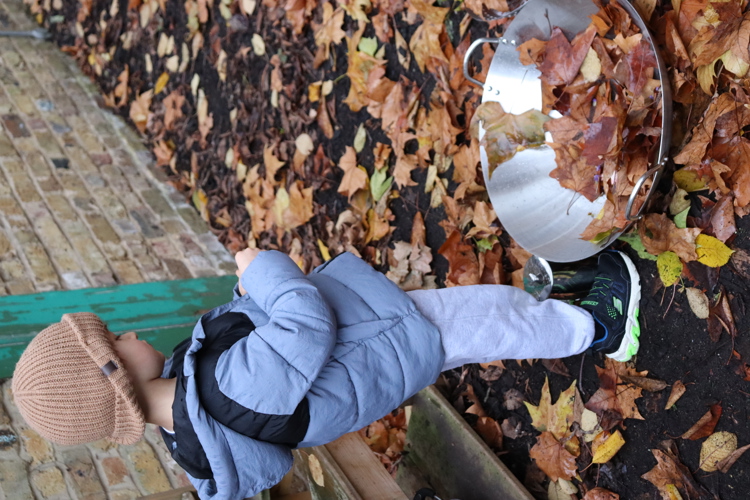
Large-scale play is especially powerful in outdoor environments, where space enables children to move freely and take manageable risks. Climbing on uneven surfaces, building tall structures, or carrying heavy objects helps children develop confidence, coordination, and resilience.
It also provides a platform for re-enacting real-world experiences, whether that’s running a café, setting up a market stall, constructing a campsite, or building a whole neighbourhood. Through this, children make sense of the world around them, engage in meaningful social interactions, and gain early exposure to adult roles and community life.
Expanding Learning Through Real Tools: Woks, Colanders, and Sieves
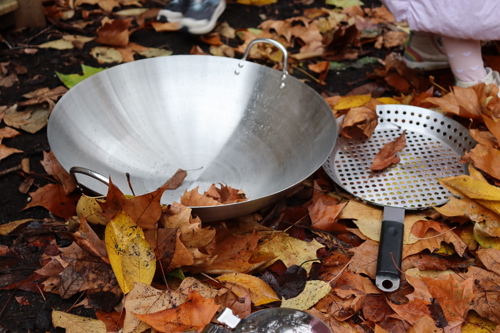
One of the richest ways to enhance large-scale play is by introducing authentic, functional tools—especially from the kitchen. Items like woks, colanders, sieves, strainers, ladles, whisks, and tongs that invite children to explore materials in dynamic and culturally meaningful ways.
Real Tools, Real Learning
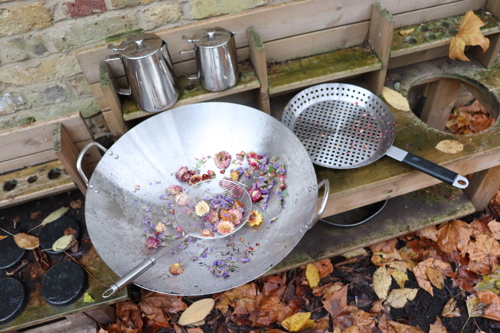
Larger kitchen utensils are often big enough to require whole-body movement. A wok, for instance, demands two-handed lifting, careful balancing, and controlled tipping, supporting coordination and strength. A colander becomes a tactile discovery tool—perfect for straining water, collecting leaves, scooping gravel, or observing how mud behaves as it drains. A sieve introduces natural scientific inquiry: What passes through? What doesn’t? Why?
These tools promote both intentional exploration and spontaneous experimentation, enabling children to link imaginative play to the physical realities of how things work.
Cultural Exploration Through Cooking Tools
Introducing woks, steamers, spice tins, tortilla presses, or rice strainers naturally broadens children’s cultural awareness. These materials provoke curiosity:
• “Why is the bottom of the wok curved?”
• “Why does this tool have holes?”
• “What foods go in a steamer?”
• “Who uses chopsticks?”
Such questions open space for discussing family traditions, diverse cuisines, and shared community experiences. Children begin to appreciate that food—and the tools used to prepare it—can look and feel different across cultures.
STEM Opportunities Embedded in Play
Play with woks, colanders, and sieves creates rich opportunities for early STEM learning:
Physics & Forces
• Children observe rolling and sliding in a curved wok.
• They explore flow, volume, and pressure through colanders.
Mathematical Thinking
• Comparing capacities of containers.
• Using vocabulary like full, empty, more, less, heavy, and light.
Scientific Investigation
• Testing materials in sieves (pebbles, sand, leaves, bark).
• Exploring states of matter and changes in texture, especially in mud kitchens and water play.
Imaginative and Social Play at Scale
A large outdoor ‘restaurant,’ ‘street kitchen,’ ‘food truck,’ or ‘home corner’ becomes an energetic hub of socio-dramatic play. Children negotiate roles, create menus, record orders, prepare ‘meals,’ and solve problems together, using authentic tools that add realism and excitement.
Because these tools are real—and often sturdy—children learn how to use them safely and respectfully, fostering autonomy, responsibility, and a sense of competence.
Large-scale play transforms learning into an embodied, imaginative, and socially rich experience. It enables children to construct worlds they can step into, encourages ambitious vocabulary, and supports gross motor development. When enhanced with authentic tools from the real-world, it becomes a powerful bridge between imaginative play, cultural understanding, scientific exploration and real-life learning.
By offering generous space, diverse materials, and opportunities for open-ended discovery, educators empower children to shape their environments—and themselves—through dynamic, immersive play. When children are given room to move freely and the freedom to manipulate large, meaningful objects, they begin to understand themselves as capable, creative agents in their own learning. They learn that environments are not fixed but malleable, and that their ideas have the power to transform ordinary spaces into extraordinary worlds.
Large-scale play supports children in developing a deep sense of ownership and belonging within their learning community. As they build, negotiate, collaborate, and problem-solve, they experience what it means to contribute to a shared project and see the tangible impact of their actions. This builds confidence, self-regulation, and social competence—skills that underpin wellbeing and lifelong learning.
Ultimately, dynamic, immersive play invites children to see themselves as empowered learners—individuals who can imagine possibilities, take initiative, think critically, and work collaboratively to bring their ideas to life. By thoughtfully designing environments that honour children’s curiosity, agency, and cultural identities, educators create the conditions for children not only to grow, but to flourish.