The Power of Sand and Water in the Early Years
Published on 02/01/2026 in Sensory, Messy & Creative Play

Kindly written for Hope by Emalee Caton, Early Years PANCo Lead Tutor at NDNA
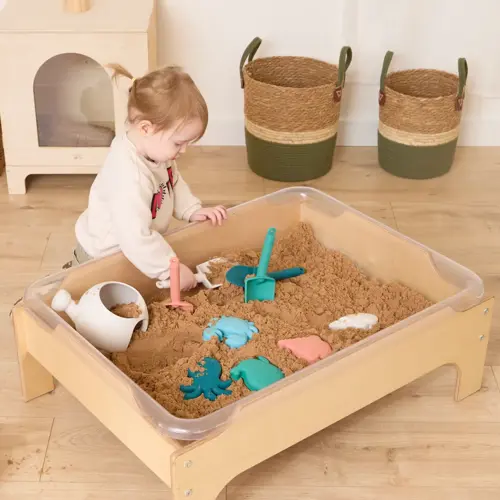
Sand and water play is a core element of early childhood settings, offering simple, accessible and deeply rich learning experiences. Whether children run their hands through dry sand, mould wet sand or explore the diverse properties of water, they engage with early scientific ideas, develop fine and gross motor skills, build relationships and discover how the world works. At its heart, this play promotes exploration, discovery and cause and effect because the materials respond instantly, encouraging problem-solving, awe and wonder, and sustained, self-directed learning.
Although often grouped together, dry sand, wet sand and water each have different properties, offering unique learning opportunities across the early years.
Dry Sand
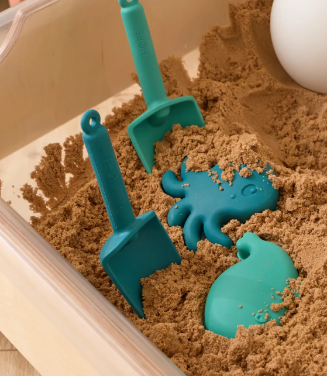
Light and constantly moving, dry sand flows almost like a liquid. It encourages children to explore movement, quantity, texture and gravity. Babies delight in watching sand slip through their fingers, while toddlers and preschoolers strengthen their hand–eye coordination as they scoop, sieve and transport it. Using soft silicone buckets, children can compare how many scoops are needed to fill smaller versus larger containers, supporting early mathematical thinking.
Wet Sand
Add water and sand transforms! Wet sand sticks, moulds and holds its shape, becoming an ideal material for building and sculpting. Babies and toddlers enjoy filling silicone moulds and discovering what happens when they turn them out, while preschoolers can investigate why dry sand won’t hold the shape and then problem-solve the right amount of water to use to create the perfect mould. These free explorations support early scientific thinking as well as deepen the children’s understanding of cause and effect.
Water
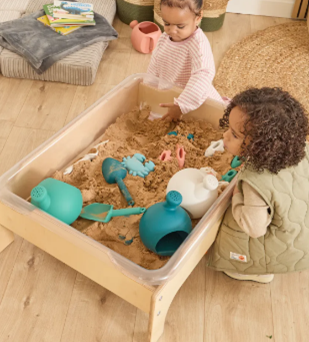
Water is dynamic, infinitely engaging and hugely popular. It pours, splashes, ripples and reflects. Babies enjoy the changing temperatures and the different texture water has to offer, while toddlers are able to explore capacity using the soft silicone funnels, watering cans and lots of different containers. Older children can begin to investigate concepts such as floating and sinking, absorption and displacement— early foundations of scientific enquiry.
Dry sand, wet sand and water are simple resources, but in the hands of young children they become powerful tools for self-directed learning. The role of the adult is to provide rich opportunities and resources—and then step back, allowing the children to take the lead. As a result, the learning that emerges is both profound and joyful.